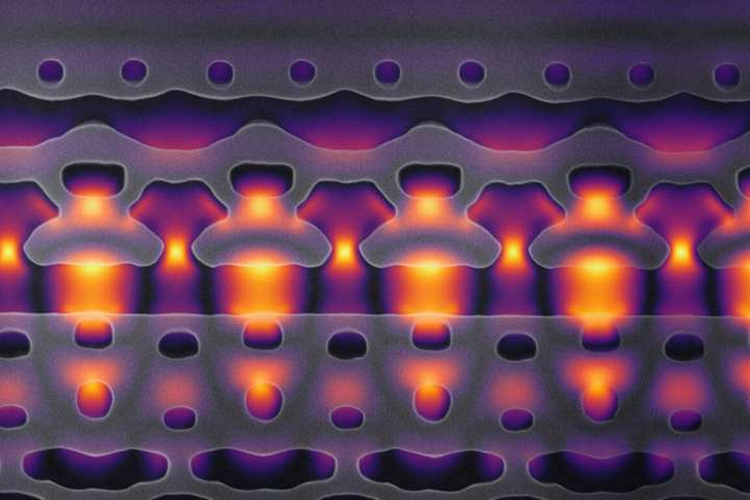
On hearing the word ‘particle accelerator’, a gigantic complex apparatus is what comes to my mind and probably, yours too. Well, that is about to change soon. Researchers at the SLAC National Accelerator Laboratory of Stanford University have come with a particle accelerator thinner than a human hair.
Yes, you read that right. This new setup is basically a nanoscale silicon channel sealed in a vacuum. The electrons are accelerated using an infrared laser.
“The largest accelerators are like powerful telescopes. There are only a few in the world and scientists must come to places like SLAC to use them. We want to miniaturize accelerator technology in a way that makes it a more accessible research tool.”, says Jelena Vuckovic, lead engineer of the project.
Vuckovic mentions that the design and fabrication of this chip could be scaled up to create particle beams suitable for futuristic experiments in chemistry, materials science and biological discovery without essentially requiring a huge full-blown particle accelerator.
The team created inverse design computer algorithms to make this achievement possible. The algorithm enabled scientists to take a bottom-up approach towards arriving at this result. The scientists used the algorithm to build the right nanoscale structures for the system to work.
The goal of researchers is to accelerate electrons at 1 million electron volts (1MeV). The current model offers only a single stage of acceleration. To achieve 1 MeV, about 1,000 stages would be required. A new model capable of thousand stages measuring roughly an inch is expected by 2020 if things don’t go wrong.
The chip could even be used in medical fields, according to Robert Byer, a co-author of the research paper. Notably, Byer leads a broader initiative called Accelerator on a Chip International Program. “It might be possible to deliver electron beam radiation directly to a tumor, leaving healthy tissue unaffected,” he said.
With all that said, it is worth keeping in mind that this new chip is still on its prototyping stages for now. We will have to wait to see how this technology progresses and makes it to real-world applications in the future. Until then, let us know your thoughts on it in the comments.